
-
Understanding the different types of shock is essential.
-
-
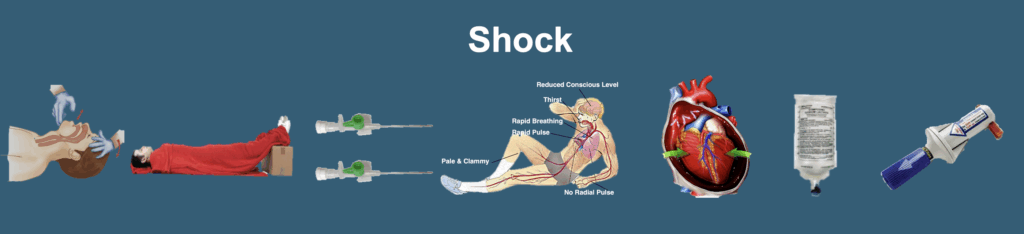
The ATLS Casualty Assessment
- S.A.F.E. Approach
- Quick Look Primary Survey
- Assess Airway:
- Perform Manual Airway manoeuvre : Head tilt Chin Lift (Jaw Thrust if C-Spine injury suspected).
- Suction airway if secretions present.
- Insert Basic Airway Adjunct.
- Primary choice should be Oro-Pharangeal Airway
- Reassess Airway
- Assess Breathing: (RISE / FALL)
- Ventilate with 100% oxygen.
- Non-rebreather mask if RR > 9 Or < 43 (O2 @ 15L/min)
- Ventilate with B.M.V. if RR < 8 Or > 44 (O2 @ 15L/min).
- Reassess Breathing.
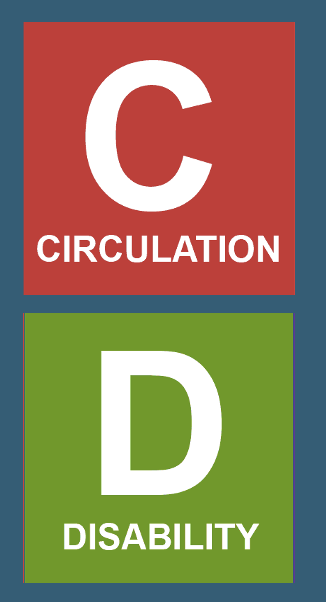
- Assess Circulation: Take a Pulse Rate, Estimating Blood Pressure
- Apply pressure to hemorrhages (Immediately if catastrophic… takes priority over AIRWAY).
- Applying tourniquet (Immediately if can’t be controlled).
- Reassess Circulation.
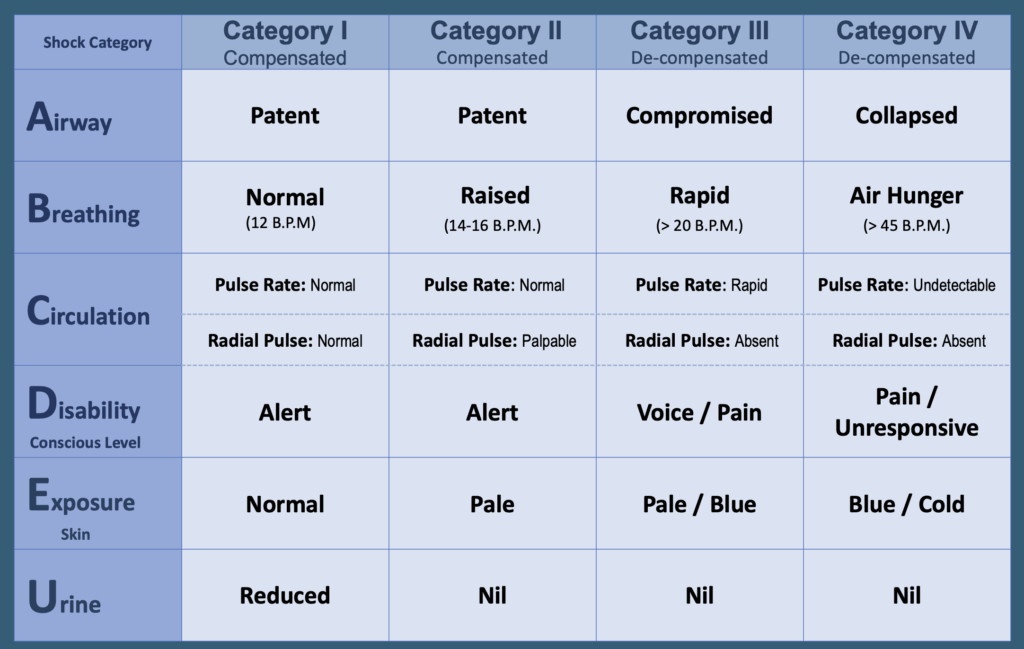
The DMT must be able to quickly identify the symptoms of Shock:
- ⬆︎ Respiratory Rate
- ⬇︎ Blood Pressure (loss of radial pulse if B/P is below 90mm/hg systolic)
- ⬆︎ Heart Rate
- ⬇︎ Urine output
If these are present the DMT MUST assume shock is present. All shock will have these generic symptoms
- Hypovolaemic Shock; Pale / Cold / Clammy / Possible lots of blood!
- Cardiogenic Shock; Pale / Cold / Clammy / Cold Feet
- Septic Shock; Hot / Clammy
- Neurogenic Shock; Flushed / Hot dry skin
- Anaphylactic Shock; Blotchy red skin (Trunk, neck & arms), Swelling: (Eyes, neck swelling, Swollen tongue / airway. Breathing difficulty (Wheezy, similar to Asthma).
Treatment of Shock:
- Treat underlying cause: Stop bleeding, take out of heat, give episodes-pen(anaphylaxis) etc..
- Rapidly gain vascular access. (IV Cannula or intra-osseous)
- Administer Intravenous IV Fluid (IVI).
- DMT Course Manual; Section 3.3.1 to 3.3.6
Now proceed to the quiz: > > > > > >
-
LST Exam Prep Course
Background Colour
Font Face
Font Kerning
Font Size
1
Image Visibility
Letter Spacing
0
Line Height
1.2
Link Highlight
Paragraph Width
0
Text Alignment
Text Colour