
-
Effective umbilical management is a vital aspect of dive safety and is an integral part of Dive Supervision.
-
-
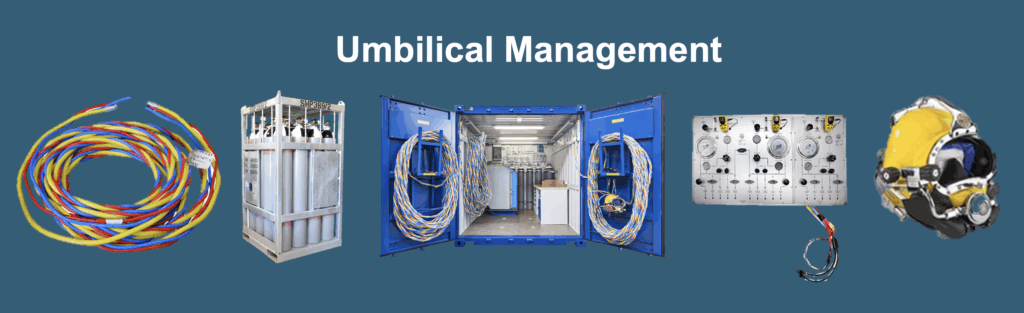
For passive (unmanned) tending the following constraints apply to the safe working distance for the working diver’s umbilical:
Cmax = D – 5 metres
OR
Cmax = A – 5 metres, depending which distance is shorter
AND
B is always less than C (This is to allow, in the event of an emergency, direct recovery of the diver to the deployment device.)
Where:
- A = distance from the deployment device to the nearest physical hazard
- B = distance from the deployment device to the in-water tending point
- C = distance from the in-water tending point to the diver
- D = distance from the in-water tending point to the nearest physical hazard
Another useful Formula, used in Diving from DSV’s is:
FORMULA: a² + b² = c²
a = diver’s depth
b = thruster distance
c = umbilical length
Example:
A DSV has a draught of 5 metres and its thrusters are 20 metres from the dive station. The diver is at a depth of 40 msw. What is the maximum permitted length of his umbilical?
a = diver’s depth minus DSV draught.
= 40 – 5 = 35 metres
b = 20 metres.
Therefore: –
35² + 20² = c²
1225 + 400 = c²
√1625 = c
c = 35 metres maximum umbilical length.
- IMCA D022. Guidance for Diving Supervisors Manual, section 8.22 (Umbilical Handling on DP Vessels)
- IMCA D010 Diving Operations from DP vessels, section 7, 10.3 (Diving Operations from Vessels Operating in Dynamically Positioned Mode)
- IMCA D015 . Mobile portable daughtercraft surface supplied systems
- IMCA D018 Code of Practice for The Initial and Periodic Examination, Testing and Certification of Diving Plant and Equipment.
- HSE ACoP 1997. Commercial diving projects offshore: Diving at Work Regulations 1997.
- IMCA D014 IMCA International COP. Section 7.3.20
TRY THE QUIZ >>>>
-
Bell Diving Supervisor (BDS) Exam Prep Course
Background Colour
Font Face
Font Kerning
Font Size
Image Visibility
Letter Spacing
Line Height
Link Highlight
Paragraph Width
Text Alignment
Text Colour